Five digital colorways do not necessarily mean five different garment meshes
A digital collection can advertise several variants while using one shared geometric form. Read the variant claim before counting unique shapes or inferring size choices. The glTF material-variants extension provides a concrete example of how multiple surface combinations can coexist within one asset.
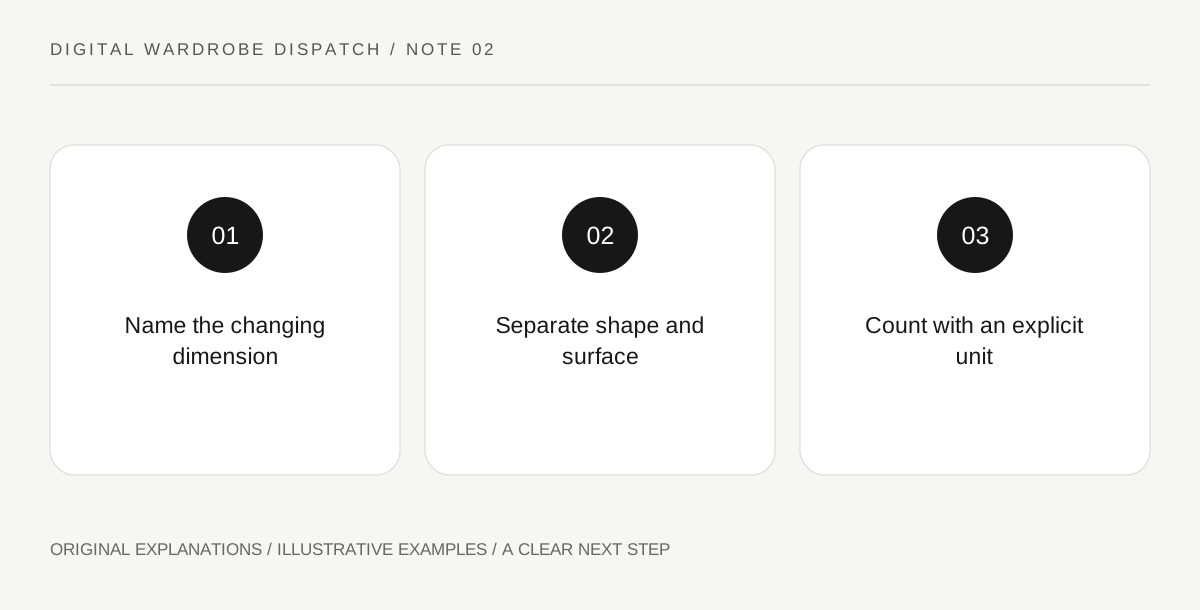
Original explanatory diagram. Read the full method and limitations below.
Identify what varies in the announcement
Look for whether variant refers to material, colorway, shape, size or a commercial package. These are different dimensions. Khronos's material-variants extension represents combinations of materials mapped to parts of a glTF asset. It is a useful technical example of a surface-choice mechanism. Do not assume an announcement uses that extension merely because it shows several colors; the actual implementation still needs documentation. The format example explains a possibility, not an invisible feature you have personally inspected.
Keep geometry separate from material choice
A material combination can change the appearance of selected parts without establishing a different cut, silhouette or mesh. Write the claimed change in a precise field. If five product images share the same shape and different surfaces, the images alone do not reveal how many source files or meshes exist. Ask for the actual asset description when that distinction matters. Avoid either inflating the collection count or dismissing the creative work involved in well-designed surface variants.
Do not infer sizing from variant labels
Small, medium or another variant name might refer to a commercial label, a geometry change or something else in the actual product. The material-variants mechanism itself does not prove body fit or garment dimensions. Check what the asset and destination actually support. A viewer's ability to switch appearances is not a virtual fitting assessment. This boundary matters when a consumer-facing page places material selectors beside physical-product sizing language and leaves their different functions unclear.
Report the count with a clear unit
Use wording such as five documented material combinations if that is what the primary information establishes. Keep unique silhouettes, files, platform items and purchase options in separate counts. A reader can then understand what the collection offers without interpreting a large number as evidence of more geometry or broader compatibility. If the source supplies only a promotional variant total, attribute it and identify the missing unit. Accurate counting is a useful editorial service even when the technology remains visually impressive.
Illustrative worked example
Illustrative editorial scenario: a fictional collection page announces six versions of one digital coat. The technical description identifies six material combinations applied to the same form. The editor reports six surface variants and one documented silhouette, leaving file packaging and platform availability as separate questions. No source-file inspection or performance test is claimed from the images alone.
Questions that come up
Does a different colorway count as meaningful design work?
It can. The distinction is about describing what changes accurately, not assigning a universal creative value to geometry versus surface design.
Can the extension guarantee all viewers display every variant?
Do not infer destination support from the existence of a format feature. Check the actual viewer and release documentation for the relevant implementation.
References and scope
These sources support the factual background. Examples and exercises are original illustrative teaching material. References do not imply endorsement.
- Khronos: glTF Material Variants — The extension represents material combinations mapped to primitives; it does not itself specify garment sizing or a change of geometry.