A digital cloth setting is not a certified measurement of the physical fabric
A simulation panel can use familiar words such as mass, stiffness and damping while still requiring context before it describes a real textile. Read a physical-match claim through its evidence. A plausible drape and a material name do not independently establish calibrated correspondence to a particular manufactured fabric.
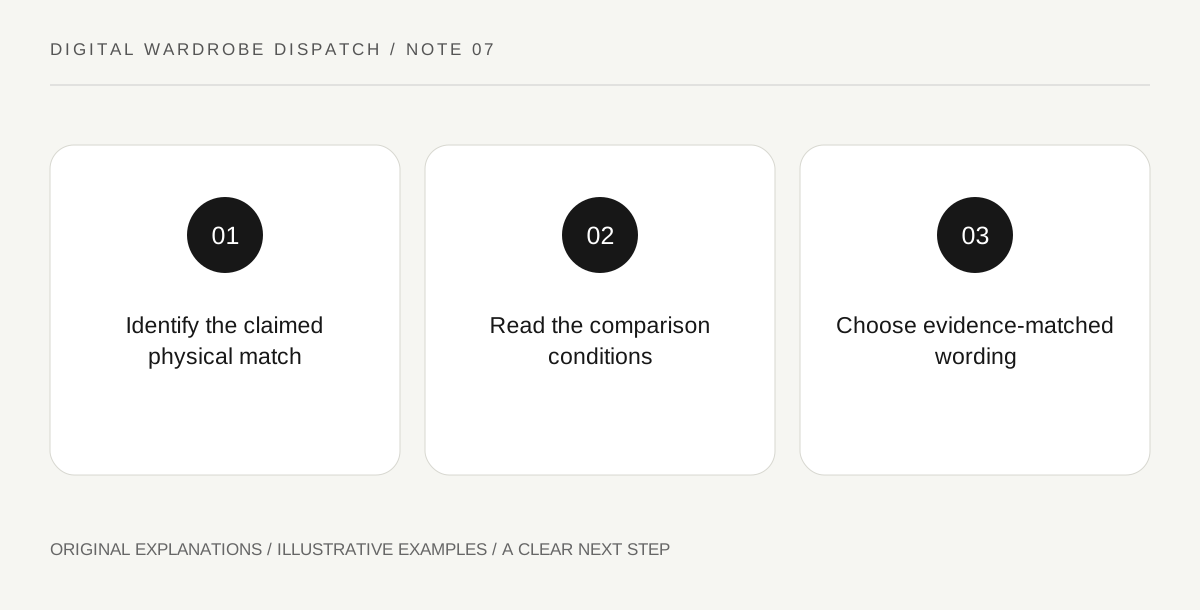
Original explanatory diagram. Read the full method and limitations below.
Separate the parameter from the specimen
Blender's cloth manual documents settings for properties including stiffness and damping. Those controls describe a simulation system. If an announcement says the result matches a physical textile, ask which specimen, measurements and method support that stronger statement. A preset called silk can provide a starting direction without identifying every weave, finish or production batch sold as silk. Keep the named physical material and the actual computational setup as separate facts.
Ask about the comparison task
A physical-match claim should explain what was compared: hanging drape, a bend, movement or another defined behavior. Different tasks expose different characteristics. An attractive still image may not address the same question as a garment moving around a body. Avoid inferring a comprehensive material match from one favorable pose. The editorial task is to identify the demonstrated behavior and the conditions, leaving untested claims visible rather than expanding a narrow example into universal accuracy.
Read the measurement context
Look for scale, garment construction and other relevant setup information in the maker's documentation. A simulation parameter cannot be interpreted independently of the system using it. Do not copy a number from a screenshot and treat it as a transferable laboratory value across applications. If a commercial workflow relies on the correspondence, seek qualified technical information appropriate to that task. This reading guide does not calibrate a simulator or certify a textile from a public video.
Use careful language for the result
Describe the work as a simulation study, a maker-claimed match or a documented comparison according to the evidence available. Keep aesthetic resemblance separate from a quantified physical-validation claim. A digital garment may intentionally exaggerate movement for expression, which can be a coherent design choice. Labeling that choice makes it understandable. Readers can appreciate plausible or imaginative drape while knowing whether the release offers an engineering claim, an artistic interpretation or both under stated limitations.
Illustrative worked example
Illustrative scenario: a digital collection says its flowing dress uses a silk-like preset. A draft upgrades this to exact silk physics. The editor asks for the physical specimen and comparison method, finds no such evidence supplied and retains the narrower simulation description. The visual design remains interesting, while the unsupported measurement claim is removed.
Questions that come up
Does a realistic-looking fold prove physical accuracy?
It can support a visual impression, but a physical correspondence claim needs a defined comparison and relevant evidence.
Can the same stiffness number be copied between tools?
Do not assume equivalent interpretation across systems. Read each tool's documentation and the actual calibrated workflow before treating a parameter as transferable.
References and scope
These sources support the factual background. Examples and exercises are original illustrative teaching material. References do not imply endorsement.
- Blender: Cloth Physical Properties — Simulation has settings including stiffness and damping; settings are not automatically measurements of a particular real textile.