Used and required are different words in a glTF compatibility claim
A file can mention a glTF extension without making every application capable of interpreting it. Learn the distinction between used features, required support and the destination's documented implementation. This reading exercise helps assess a digital garment announcement without pretending that a filename alone proves identical behavior across viewers.
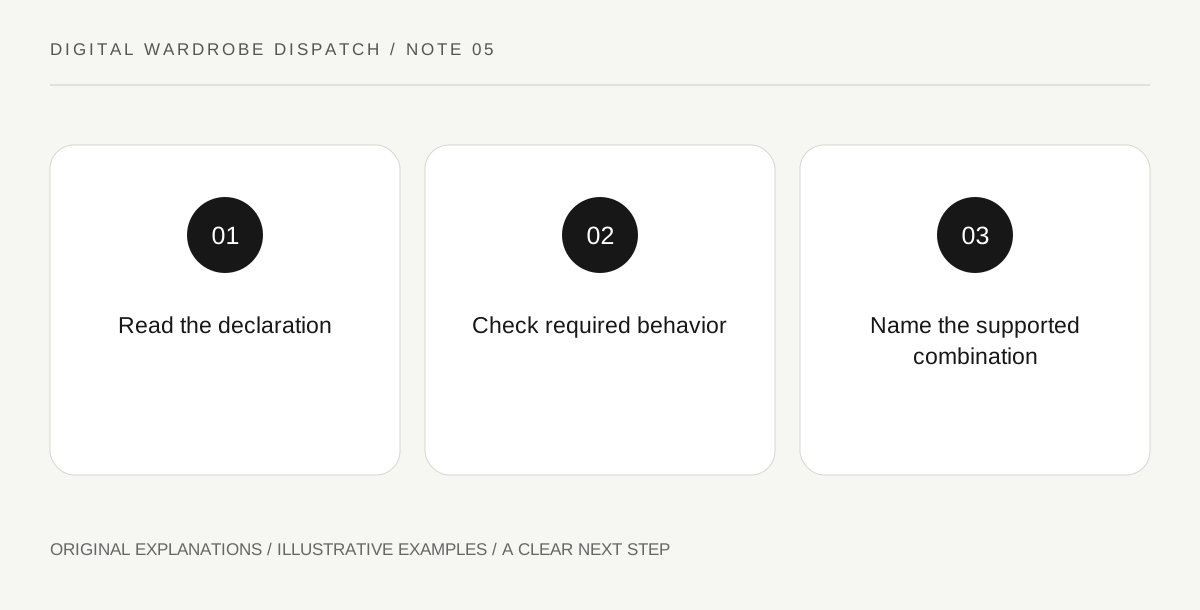
Original explanatory diagram. Read the full method and limitations below.
Read the feature declaration precisely
The glTF specification distinguishes extensionsUsed from extensionsRequired and requires the latter to be a subset of the former. These are format declarations, not endorsements from every software developer. Keep the named extension with its actual role in the asset. A statement that a feature exists in the format should not become a statement that the reader's chosen app supports it. The application has its own implementation and release documentation.
Ask what happens without support
A feature can have an allowed fallback, while another required feature may be essential to proper consumption of the asset. Read the relevant specification and product explanation rather than inventing the outcome. Do not assume an unsupported effect simply disappears harmlessly in every case. Conversely, a fallback presentation may still serve a limited task. The useful question is what the documented asset and viewer combination is expected to do, including any known limitation.
Separate file validity from application behavior
An asset can conform to format rules without every destination implementing its features. A successful import is also narrower than a complete visual or animation acceptance result. For an editorial report, ask which application, version and relevant feature were actually demonstrated. Avoid claiming personal testing from a launch video or a validator screenshot supplied by another party. Attribute that evidence and preserve its stated conditions so readers can assess how closely it matches their own intended use.
Write a bounded support statement
A clear dispatch names the format feature and documented destination rather than saying works everywhere. If support remains unknown, identify the missing information explicitly. You can still explain why the feature matters to a garment's appearance or delivery. A compact compatibility note should help a reader decide whether to investigate further, not ask them to buy a file on the strength of a familiar extension name. No conversion shortcut replaces a missing support statement.
Illustrative worked example
Illustrative scenario: a digital outfit announcement says its asset uses a material extension. A reader assumes every glTF viewer will display the same effect. Checking the specification and destination documentation reveals the separate questions of declaration, required support and fallback. The resulting note names the documented combination and leaves other destinations unverified, without claiming an import test was performed.
Questions that come up
Does glTF support mean every glTF extension is supported?
No universal conclusion follows from the broad format name. Check the actual implementation and the features used by the asset.
Does a validator replace a destination review?
It answers a different question about the asset and its rules. Application support and the observed result need their own relevant evidence.
References and scope
These sources support the factual background. Examples and exercises are original illustrative teaching material. References do not imply endorsement.
- Khronos: glTF 2.0 Specification — Required and used extension lists, asset metadata and format structure; support claims remain implementation-specific.