A digital garment scan can record surface appearance and shape through different data
A convincing scan-based garment can combine geometric structure and surface imagery. Learn to distinguish those contributions when reading a digitization announcement. A visible seam or embroidered detail may appear through image information, geometric form or both, with different implications for how the model can be inspected.
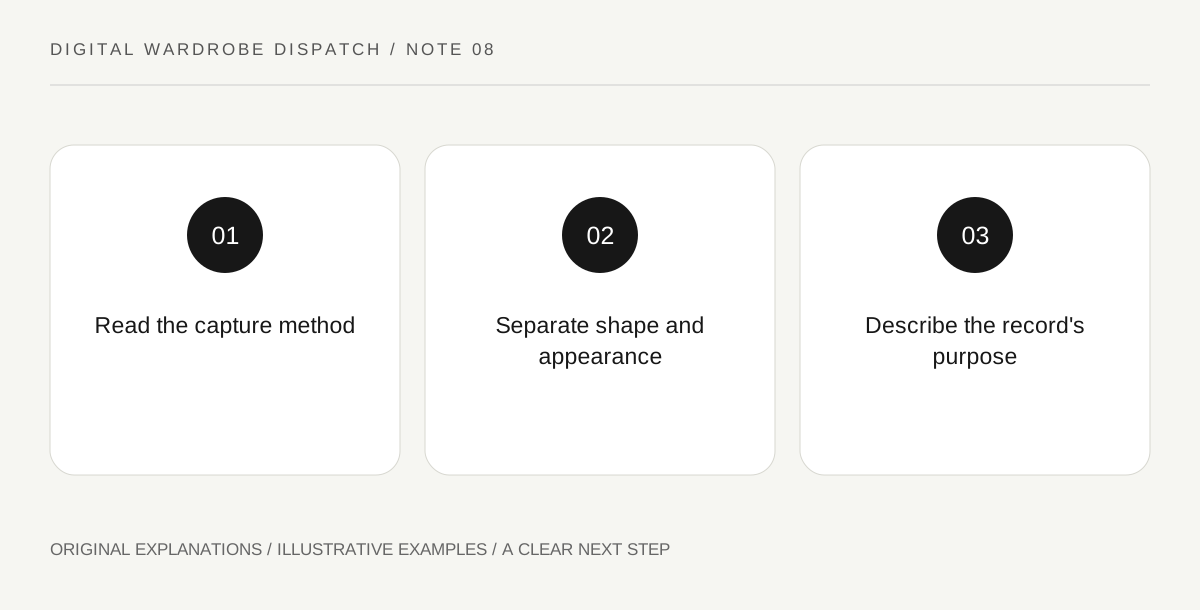
Original explanatory diagram. Read the full method and limitations below.
Identify the documented capture method
Smithsonian research describes three-dimensional imaging techniques that document object geometry and texture. That primary account provides a useful distinction without proving how any particular fashion asset was made. Read the project's own capture description and identify the object studied. Do not infer that a historic garment was scanned merely because its render looks photographic. A modeled reconstruction and a captured object can share visual characteristics while having different evidence behind them.
Separate visible detail from geometric relief
Ask whether a feature is represented by shape data, a surface image or another documented rendering method. A dark stitched line can look convincing from one angle without being a raised geometric seam. That does not make the representation useless; it defines what it can demonstrate. Keep the intended task in view. A visual catalog preview and a detailed geometric measurement study need different kinds of information, so the same asset may support one better than the other.
Look for incomplete or inaccessible regions
Garments can contain interior areas, folds and overlapping layers that complicate a complete record. Seek documentation of what was captured, omitted or reconstructed rather than treating a seamless viewer as proof that every surface was directly observed. Do not invent a missing back panel from a front photograph and call it captured evidence. If the project provides different confidence levels or documented processing stages, preserve them in the summary so readers can understand the representation's boundary.
Describe the digital record by its purpose
A dispatch can say the project offers a visual surface record or a documented three-dimensional study, according to its actual scope. Avoid calling it an exact digital duplicate without explaining what exactness covers. File resolution, capture precision and texture appearance are distinct questions. A scan-based asset also has its own access and reuse conditions. The availability of an interactive view does not automatically mean raw capture data or editable source material is supplied to every reader.
Illustrative worked example
Illustrative editorial scenario: a digitization page shows embroidery clearly on a garment model. A draft assumes every thread is individually modeled. The project documentation identifies surface imagery as part of the representation. The editor describes the visible detail accurately and asks separately whether geometric relief was recorded. No inspection of hidden source data is claimed from the preview alone.
Questions that come up
Does texture detail make a scan less useful?
Not inherently. Its usefulness depends on the task and documented scope, such as visual access versus precise geometric analysis.
Can an interactive viewer prove all source data is downloadable?
No. Viewing access, delivered model files and raw capture data are different release choices that need their own documentation.
References and scope
These sources support the factual background. Examples and exercises are original illustrative teaching material. References do not imply endorsement.
- Smithsonian: Reflected Infrared and 3D Imaging — Object digitization can document geometry and texture; this is not a claim that a specific garment was scanned.