A certified 3D viewer does not automatically certify the digital garment inside it
A digital-fashion announcement can place a certification logo beside a beautiful garment render and leave the reader unsure what was assessed. Identify the object of certification before repeating the claim. A viewer program, a file and a commercial wearable are related parts of a presentation, with different evidence needs.
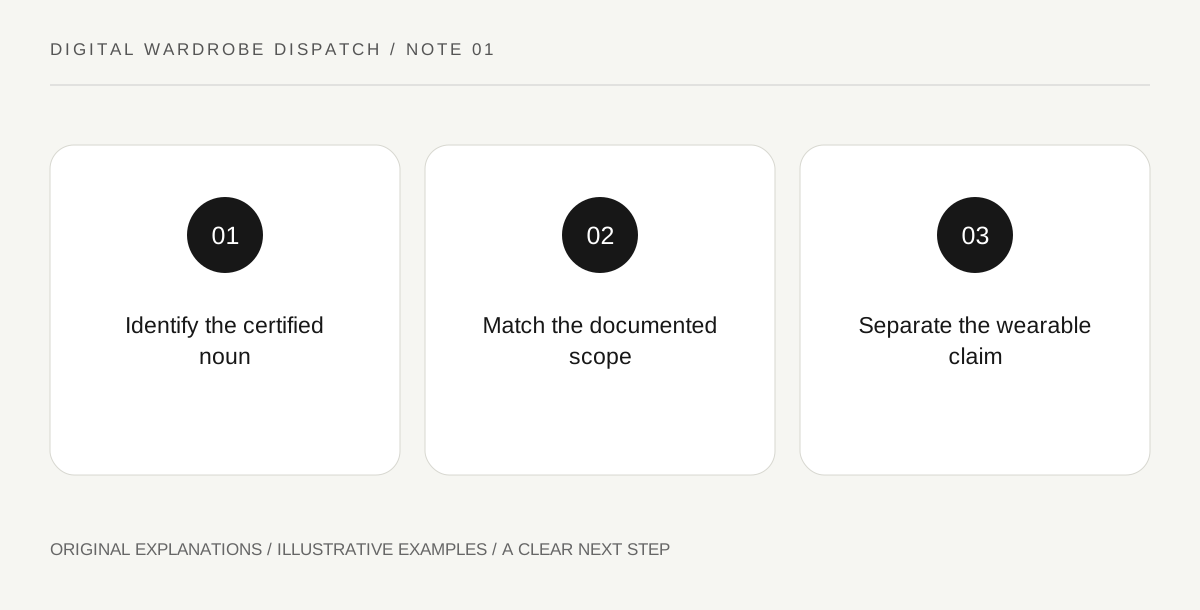
Original explanatory diagram. Read the full method and limitations below.
Name the thing the program evaluates
Khronos's 3D Commerce certification documentation describes a program for viewers capable of displaying commerce assets according to its requirements. That is a defined rendering-program scope. When reading an announcement, underline the noun attached to certified. If it is the viewer, retain that noun in your summary. Do not let a nearby garment image silently turn the sentence into a claim that the garment's design, fit, commercial rights or marketplace eligibility has been certified by the same program.
Keep the claim attached to its actual version
Look for the viewer identity and any version or certification reference supplied by the program and announcement. A statement about one rendering implementation should not be generalized to every app produced by the same company. Record what is actually documented and leave missing details unresolved. If the material is a press release, attribute its claims as such. You can explain the program's purpose without presenting a promotional statement as your own completed independent test.
Separate rendering from the wearable promise
An attractive consistent display answers a different question from whether a garment can be equipped on a particular avatar or used under particular terms. Those latter claims need their own primary platform, product and permission information. Do not assume that a rendering mark supplies them. This is an editorial inference from the program's defined object, not an allegation that the garment is defective. The useful distinction is which question the evidence actually addresses and which question remains open.
Write a narrow dispatch sentence
Summarize the supported claim with its object, source and limitation. A clear sentence can say that a collection is shown in a named viewer associated with a particular program, while avatar availability is described separately. Avoid adding unsupported claims of universal color accuracy or guaranteed appearance on every display. Readers benefit from an understandable boundary more than an impressive stack of logos. If a material detail is not verified, mark it as unverified instead of filling the gap from the visual polish of the page.
Illustrative worked example
Illustrative editorial scenario: a launch page places a viewer-certification badge beside a digital jacket. A draft calls the jacket certified. Checking the primary program documentation reveals that the relevant object is the viewer. The editor corrects the sentence and asks separately whether the jacket is a downloadable asset or a platform wearable. The correction preserves the legitimate rendering claim without extending it to unrelated product promises.
Questions that come up
Does a rendering certification prove garment fit?
Not from the stated viewer-program scope. Fit and avatar operation require relevant evidence for the actual asset and destination.
Should a certification logo be ignored?
No. A legitimate defined program can provide useful information. The editorial task is to retain its actual scope rather than dismissing it or expanding it beyond the evidence.
References and scope
These sources support the factual background. Examples and exercises are original illustrative teaching material. References do not imply endorsement.
- Khronos: 3D Commerce Viewer Certification Program — The program certifies viewers against its rendering requirements; a viewer claim has a different object from an individual garment asset.