A platform-policy story needs an effective rule and a version trail
Digital-fashion creators can be affected by a policy update long after the announcement first circulates. Read the publication date, effective date and applicable audience separately. Preserve the relevant version so a later correction can explain what changed instead of silently treating every screenshot as the current rule.
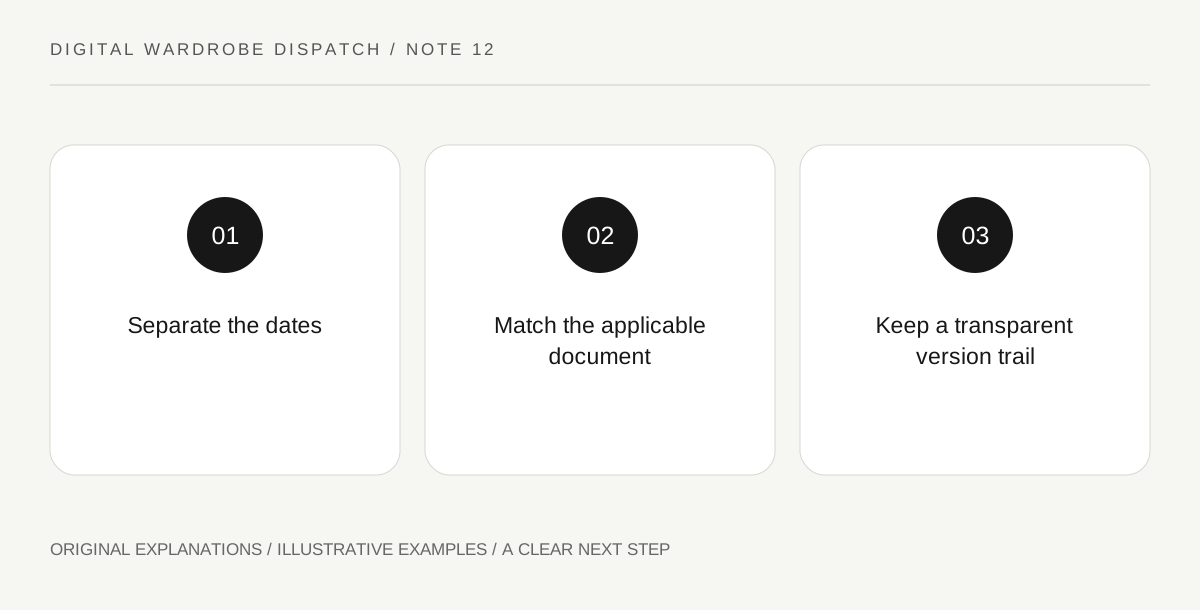
Original explanatory diagram. Read the full method and limitations below.
Separate the dates before interpreting the rule
An announcement can describe a future change, a phased transition or an already effective policy. Copy the dates stated by the platform and identify which one controls the action being discussed. A document's last-updated date is another fact again. Do not invent an effective date from a social post's timestamp. If the relationship is unclear, attribute the uncertainty and link the primary explanation rather than presenting a convenient date as settled.
Check the relevant audience and region
A platform may publish different terms or requirements for different regions, creator categories or services. Roblox's terms-update material illustrates why the exact document matters. Identify which page is being read and whether it applies to the people discussed in the article. Do not combine fragments from several regional documents into one universal rule. This is careful source handling, not individual legal advice; a reader facing a particular dispute may need appropriate qualified guidance.
Preserve a meaningful earlier reference
Keep a dated copy or appropriate record of the relevant paragraph and its source, with private account information excluded. A change comparison should show the actual old and new wording at the needed scope. Avoid relying on an unattributed screenshot whose page, region or date cannot be established. If the earlier version is unavailable, say that a comparison could not be verified. A missing record does not justify inventing what the platform used to require.
Make the consequence narrow and reviewable
Explain the action affected, such as a publication step or availability condition, and distinguish it from other unchanged assumptions. Do not predict enforcement outcomes for every creator or promise a workaround. If the platform later clarifies the rule, add a dated correction explaining the material change. Readers benefit from an honest trail of verified information more than a continuously rewritten article that hides why its advice looked different the previous week.
Illustrative worked example
Illustrative editorial scenario: a policy screenshot circulates with a claim that a rule changed immediately. The official update states a later effective date and a particular audience. The editor records both dates, links the applicable document and preserves the relevant passage. A subsequent clarification receives its own note, so readers can understand the sequence without relying on an anonymous image.
Questions that come up
Can an old screenshot establish the current rule?
Not by itself. Check the relevant live primary document and identify the screenshot's version before using it as historical evidence.
Should an article silently replace an earlier interpretation?
A material correction is clearer when dated and explained. Preserve the evidence trail without exposing private information or pretending the earlier wording never existed.
References and scope
These sources support the factual background. Examples and exercises are original illustrative teaching material. References do not imply endorsement.
- Roblox: Updating Terms of Use — A dated terms-update document is distinct from assumed current universal rules; verify relevant regional and effective text.
- Roblox: Marketplace Policy — Upload, publishing and continuing on-sale requirements are separate current policy categories; no fee or eligibility shortcut is promised.