AI assistance, human expression and a garment file license are separate questions
An AI-assisted digital-fashion release can raise several distinct questions about process, authorship and permitted use. Keep them separate in a report. A tool label does not settle the legal status of an entire garment, while a commercial license statement does not explain which expressive contributions were made by people.
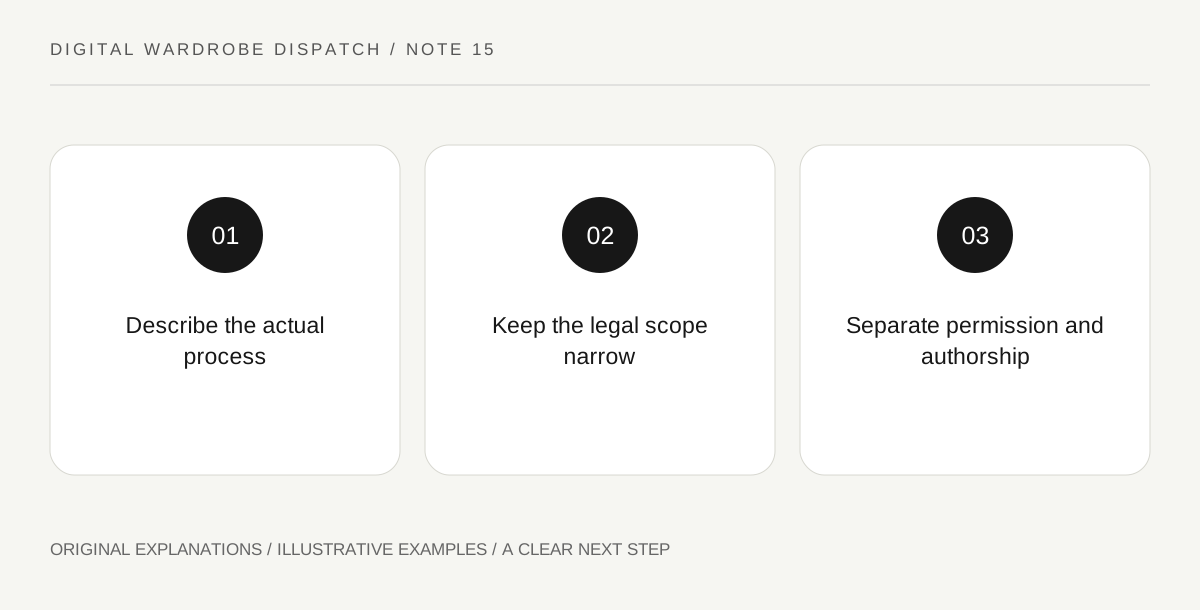
Original explanatory diagram. Read the full method and limitations below.
Describe the reported process accurately
Identify what the maker actually says the system did: concept imagery, surface exploration, mesh generation or another defined task. Do not infer an end-to-end process from one AI-related label. A human may contribute design, selection, editing and construction at different stages. Record the attributable explanation without claiming to have audited hidden working files. If the maker has not disclosed the process, state that limitation rather than constructing a confident production story from the finished image.
Use the legal source at its actual scope
The US Copyright Office's January 2025 Part 2 report distinguishes human expressive contribution from prompts alone and treats relevant questions through existing copyright principles. That is a US report with a defined date and scope. It is not a blanket ruling about every country or every digital outfit. Keep the source's general distinction separate from an individual legal conclusion, and seek qualified advice where a particular release depends on a rights determination.
Read the supplied permission separately
A seller may state terms for using the delivered asset. Read what those terms actually address and who is making the promise. Do not assume a tool-generated output automatically clears third-party material or gives the seller every right it claims. Equally, do not declare that any AI assistance erases all human-authored elements. File access, contractual permission and copyrightability are different questions. They may interact, but none should silently answer all the others.
Write an evidence-bounded account
A useful dispatch names the disclosed role of AI, the documented human contributions and any actual license claim, each with attribution. Avoid legal certainty unsupported by the available facts. A release can be discussed as a visual design without presenting an ownership verdict. Readers benefit from clear questions and source boundaries more than slogans claiming that everything is either fully protected or entirely free to reuse. Update a material legal statement when a relevant authoritative development changes it.
Illustrative worked example
Illustrative editorial scenario: a creator describes AI-assisted concept exploration followed by original human modeling and surface work. A draft calls the entire outfit automatically uncopyrightable. Reading the primary report shows that the claim is too broad. The editor reports the disclosed stages and leaves individual rights questions unresolved, with the actual asset terms discussed separately.
Questions that come up
Do prompts alone settle authorship of every final project?
The cited US report explains a narrower distinction, while a final project may contain additional human contributions. An individual conclusion requires the relevant facts and legal context.
Does a paid asset listing prove every underlying right is cleared?
No. It is a commercial offer with claims and terms to evaluate. Seek appropriate clarification where rights are material instead of treating payment as a complete legal audit.
References and scope
These sources support the factual background. Examples and exercises are original illustrative teaching material. References do not imply endorsement.
- US Copyright Office: AI Report Part 2 — The January 2025 report distinguishes human expressive contribution from prompts alone; no individual legal determination is made.