A moving digital runway is not automatically a live cloth simulation
A garment moving beautifully through a runway film can come from a prepared animation, cached simulation or another production process. Describe what is shown before repeating a real-time claim. The distinction concerns how movement is produced and replayed, rather than whether the visual result deserves creative appreciation.
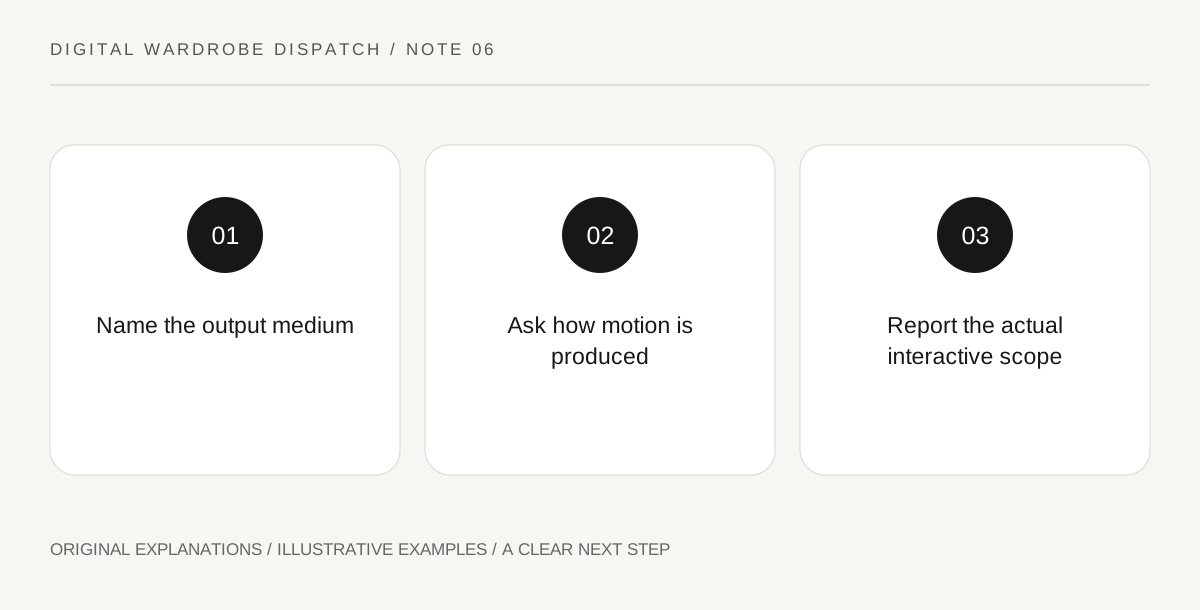
Original explanatory diagram. Read the full method and limitations below.
Identify the demonstrated output
Is the release a rendered film, an interactive application, a recorded screen capture or a file with animation data? Those outputs can look similar in a short social clip. Write the actual medium first. A video demonstrates a sequence of images; it does not by itself reveal how quickly the underlying simulation was computed. Keep the maker's process explanation separate from the motion visible on screen and attribute both appropriately in a dispatch.
Understand the cache possibility
Blender's cloth documentation describes computing simulation over a frame range and caching results. That provides a concrete reason that replayed cloth motion need not mean the same calculation is happening live during playback. It does not establish that any particular fashion film used Blender or a cache. Use the example to ask a precise production question. Avoid reverse-engineering a software pipeline solely from the smoothness or complexity of folds in the finished presentation.
Ask what real time means in context
The term may concern rendering, tracking, garment response or the whole experience. A real-time renderer can display prepared animation while another system computes cloth interactions dynamically. Name the claimed stage and conditions. If a performance number is supplied, retain the device, scene and measurement scope. A polished sequence is not a substitute for that information. Readers should understand what they could actually interact with, rather than assuming a film can become a responsive wearable without further work.
Keep creative value separate from technical classification
A carefully prepared film can be a successful digital-fashion work without being a live simulation. Do not downgrade it merely because the process is different from a reader's assumption. Instead, describe the actual medium and any verified production detail. A useful report can praise a visual idea while leaving an unsupported runtime claim out. The distinction prevents future buyers, collaborators or audiences from expecting interaction that the release never documented.
Illustrative worked example
Illustrative editorial scenario: a launch film shows a cape reacting to a dramatic turn. A draft calls it a live interactive garment. The creator's process note actually identifies a prepared simulation sequence in a rendered film. The editor corrects the medium and keeps the movement description, preserving the work's visual achievement without extending it into an unverified runtime feature.
Questions that come up
Does cached motion mean the work is fake?
No. It is a legitimate production approach. The important issue is whether the release is described accurately and its claimed interaction is supported.
Can a film prove which software was used?
Visual resemblance alone is insufficient. Use an attributable maker statement or other reliable production evidence rather than guessing from the result.
References and scope
These sources support the factual background. Examples and exercises are original illustrative teaching material. References do not imply endorsement.
- Blender: Cloth Cache — Cloth simulation can be computed for a frame range and cached; no current UI tutorial is provided here.