A reconstructed historic dress should show where evidence ends and interpretation begins
A digital reconstruction can make a damaged or incomplete garment easier to imagine while adding decisions that were not directly observed. Read the project's evidence and interpretation together. Clear uncertainty makes the work more informative, allowing viewers to understand the historical argument rather than mistaking every rendered region for a surviving fact.
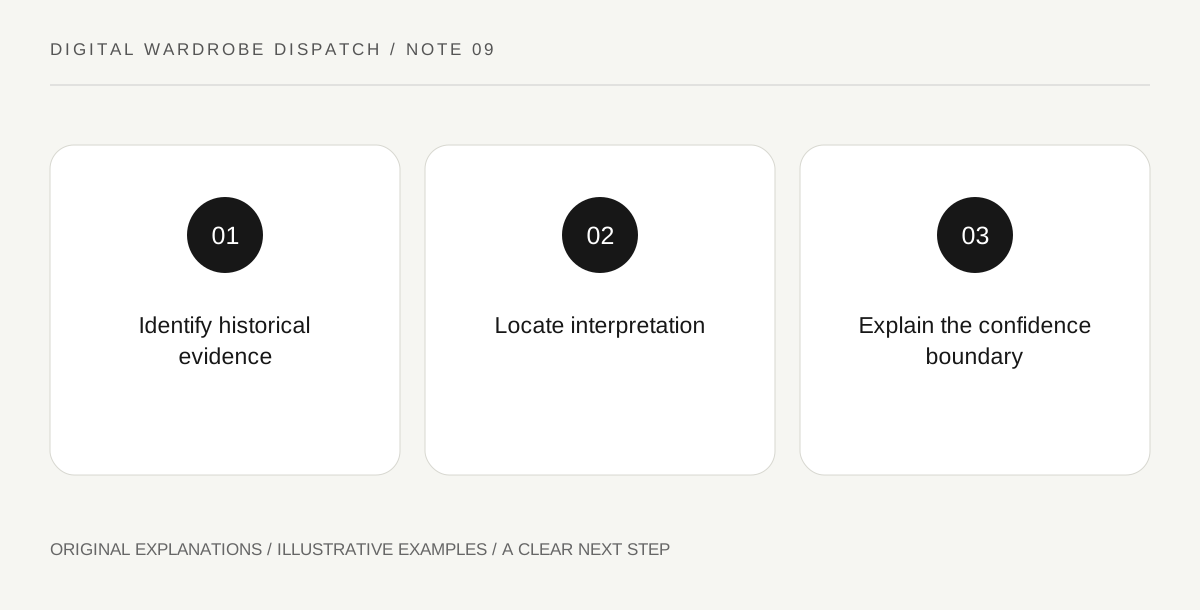
Original explanatory diagram. Read the full method and limitations below.
Identify the historical sources
Look for the physical object, catalog record, photographs, patterns or other evidence named by the project. The London Charter calls for structured documentation of research sources in heritage visualization. That principle helps assess a digital dress without requiring every viewer to reconstruct the entire research process. A general period mood board does not establish the precise construction of one garment. Keep direct evidence, related comparison and broader inspiration in different fields.
Locate the interpretative choices
Ask which parts were completed, recolored, repositioned or inferred. A missing sleeve may be reconstructed from a related garment, while a damaged surface may be visually repaired for presentation. These choices can be reasonable when explained. Do not demand that all interpretation disappear; historical visualization necessarily makes representational decisions. The useful question is whether readers can identify the choices and assess their relationship to the project's stated purpose and sources.
Read confidence without a false binary
A project may have strong evidence for silhouette and weaker evidence for original color. Those differences should not collapse into a single authentic or inaccurate verdict. Keep the claims at the level the documentation supports. If a digital garment is intended as an imaginative adaptation rather than a scholarly reconstruction, say so. The same attractive image can serve different goals, but its caption should not quietly shift from creative interpretation to historical certainty.
Write a transparent collection note
Describe the documented object and the major reconstructed elements in plain language. Link appropriate primary records and preserve the date or edition of the visualization. Avoid presenting a speculative detail as proof of a broader fashion-history claim. A clear note can invite interest while making the uncertainty visible. If the project does not supply enough information, identify that limitation rather than inventing its research method from the visual finish of the render.
Illustrative worked example
Illustrative scenario: a fictional museum dress has a surviving bodice and partial skirt. A digital version completes the skirt using comparison material and shows a proposed original color. The editor names those interpretative additions and separates them from the surviving structure. Viewers can now appreciate the reconstruction while understanding which features are evidence-based and which remain hypotheses.
Questions that come up
Does acknowledging uncertainty weaken a reconstruction?
It makes the reasoning assessable. An explained hypothesis can be useful without claiming that every rendered feature is directly observed.
Can a beautiful reconstruction establish an undocumented fashion fact?
Visual polish does not supply missing evidence. Use the actual research sources and keep conclusions within their stated support.
References and scope
These sources support the factual background. Examples and exercises are original illustrative teaching material. References do not imply endorsement.
- London Charter: Principles — Heritage visualization research sources and interpretative methods should be documented for evaluation.